
The Future of Molecular Analysis: Dr Stefan Duhr on NanoTemper’s Single-Molecule Vision

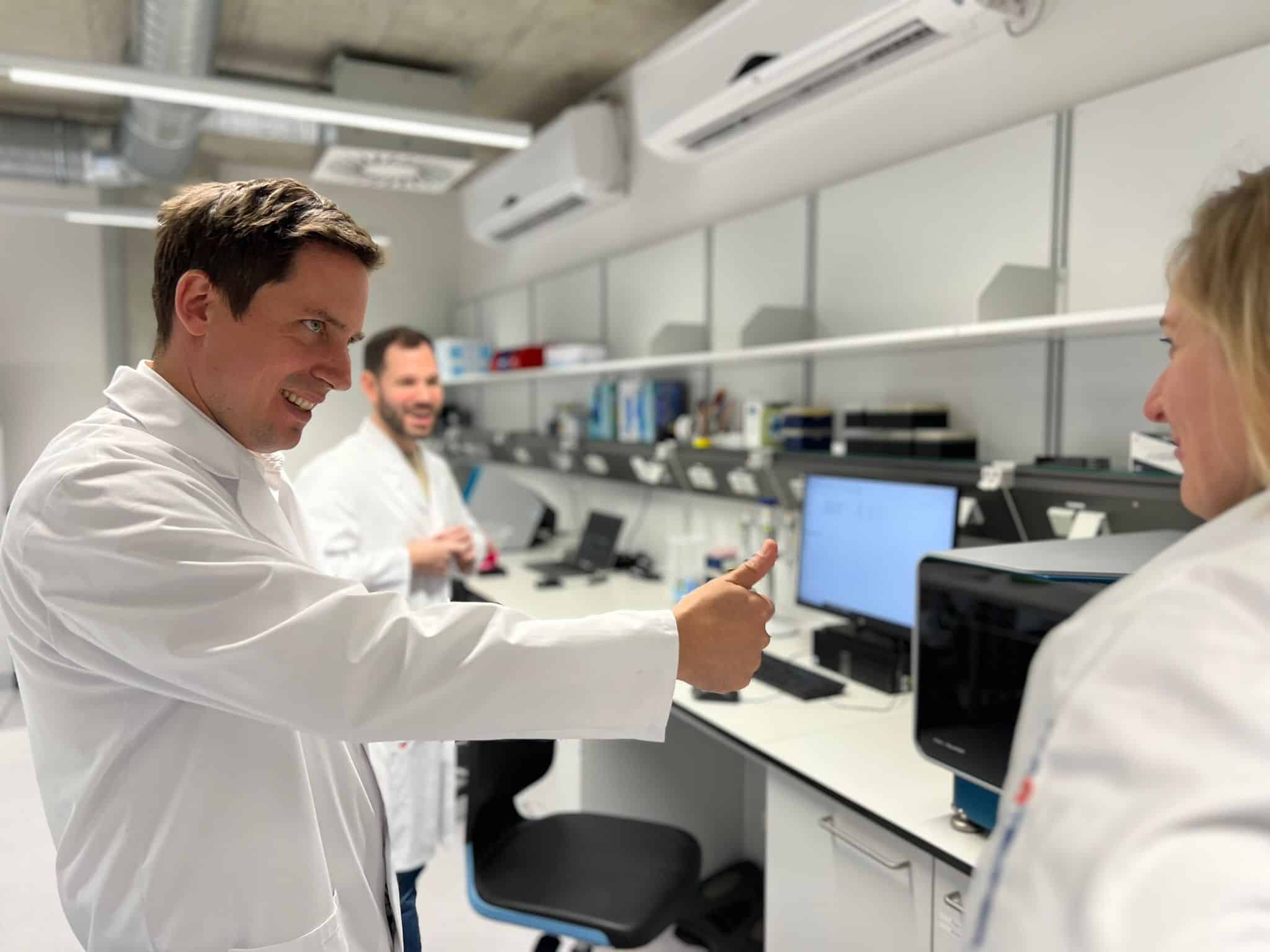
Stefan Duhr, CEO of NanoTemper, talks about the new tech that reveals hidden molecular dynamics, and how the recent acquisition fits into the company’s overall vision.
The journey from a biological target to an effective therapeutic is a marathon of meticulous decision-making. Each step in early-stage drug discovery relies on high-quality data to answer fundamental questions: Does the drug candidate bind to the target? How strong is that interaction? Does it induce a desired conformational change?
For decades, researchers have depended on ensemble measurement techniques, which average the behavior of millions of molecules, providing a useful but often incomplete picture. As a review study highlights, this averaging can mask critical heterogeneities in complex biological samples, such as the presence of inactive subpopulations or transient intermediate states. This is particularly problematic with the rise of complex new modalities like antibody-drug conjugates (ADCs), lipid nanoparticles (LNPs), and other biologics, where subtle differences in structure can dictate clinical success or failure.
Enter NanoTemper Technologies, a Munich-based life sciences company built on a vision to provide unparalleled clarity into molecular interactions. Recently, the company made two strategic moves poised to transform the biophysical analysis landscape: the acquisition of Swedish startup Envue Technologies, bringing its Nanofluidic Scattering Microscopy (NSM) for single-molecule, label-free analysis, and the launch of the Dianthus α application, which significantly advances its established Spectral Shift technology. Together, these innovations empower researchers to see more, understand more, and decide faster.
In an interview with the Drug and Device World, Dr. Stefan Duhr, CEO and Co-founder of NanoTemper, details how these latest developments are not just new products, but fundamental pillars in NanoTemper’s long-term vision to equip researchers with a 360-degree view of their molecules.
The NanoTemper Vision
Dr. Duhr outlines the core philosophy that has guided NanoTemper’s growth into one of the largest privately-owned, bootstrapped life science tool companies.
“Our vision is to help create a world where every disease is treatable,” Dr. Duhr stated. “We do so by providing biophysical optical measurement technologies that solve unmet challenges… to provide the highest quality data is one pillar, and then also the most insights into molecules. As much insight as possible out of one measurement.”
This dual focus on data quality and depth of insight has traditionally been applied to ensemble measurements. However, the acquisition of Envue Technologies marks a strategic expansion into a new dimension of analysis. “So far, we have done that high-quality and maximum insight topic on ensemble measurements on average of molecules,” Dr. Duhr explains. “With this acquisition, we’re really adding this single molecule perspective. So, things that might be obscured by the average in ensemble measurements are then visible, and that gives completely new insights to our customers.”
This shift is critical as therapeutic modalities become increasingly sophisticated. Complex molecules like LNPs used in mRNA vaccines or ADCs are not homogenous; they contain subpopulations with different efficacies and safety profiles. Seeing the average is no longer enough.
The Power of Seeing the Individual
The cornerstone of the Envue acquisition is its proprietary Nanofluidic Scattering Microscopy (NSM) technology. But what exactly is it, and why is it such a game-changer?
Traditional methods often require labelling molecules with fluorescent tags or are limited to observing the collective behavior of a sample. NSM technology bypasses these limitations. It allows for the direct, label-free observation of individual molecules in their native state, flowing through a nanofluidic channel. As Dr. Duhr passionately describes, this was a long-held ambition. “We were always dreaming of bringing single molecule technologies to our portfolio, where you don’t have to label molecules… we can just take molecules as they are and make them visible. This is really the beauty of this and where it complements our existing technologies.”
The scientific brilliance of NSM lies in its ability to measure a particle’s size and mass independently of each other without the need for calibration standards. This provides a precise, two-parameter readout for every single molecule that passes through the detector.
Dr. Duhr highlights that the technology’s ability to resolve distinct conformational subpopulations can be the difference between a drug candidate succeeding or failing in a costly clinical trial. For instance, having a level of quality control in development that was previously difficult to achieve at this resolution.
Accelerating Discovery with Dianthus α
While NSM expands the horizon into single molecules, NanoTemper hasn’t taken its eye off enhancing its core ensemble platforms. The company’s latest product, Dianthus α, introduces two key capabilities: Slow Kinetics and Optical Unfolding.
“One is slow kinetics, especially with respect to covalent inhibitors,” Dr. Duhr notes. “Ideally, you would like to design molecules that bind to that target, and then they stay on. This would allow for lower-dose drugs and overcoming resistance mechanisms. Conventional methods have some limitations in this area. It’s not so easy to measure these really slow but covalent binders.”
Covalent inhibitors represent a major class of modern drugs, but their very slow dissociation rates place them outside the detection window of standard binding assays. Dr. Duhr explains that the Slow Kinetics feature of Dianthus α allows researchers to accurately measure these long-lived interactions, providing crucial data that was previously difficult to obtain.
The second feature, Optical Unfolding, adds a critical layer of functional information. “Now with optical unfolding, we add a very precise measure for whatever is binding. What effect does it have on the stability of the protein? Does it cause aggregation of the protein?” Dr. Duhr explained. “This information was typically taken somewhere along the workflow as well, and we combine it in the end in one measurement, no additional sample, no additional time.”
This multiplexing of binding and stability data within a single experiment streamlines the workflow, saving precious time and sample material.
AI, Automation, and High-Quality Data
The pharmaceutical industry is undergoing a seismic shift towards data-driven discovery, heavily leveraging artificial intelligence (AI), machine learning, and automation. Dr. Duhr confirmed this trend, citing a recent local SLAS (Society for Laboratory Automation and Screening) meeting that saw attendance balloon from an expected 50 to 250 participants.
“This whole field is getting more and more momentum,” he observes. “The robotic cells are getting bigger, and the ways to analyze data are getting easier.”
In this context, Dr Duhr sees the role of instrumentation providers evolving. It’s no longer just about providing data but about supporting data interpretation and enabling confident decision-making. Dr. Duhr emphasized that the high-quality, reliable data generated by NanoTemper’s platforms is fundamental to training effective AI models.
“If you train with high-quality data, everything downstream will be so much better,” he states. This is a crucial point; the predictive power of an AI model is only as good as the data it’s built upon. Dr. Duhr boasts that NanoTemper’s technologies provide robust, high-fidelity biophysical data.
The Road Ahead
Looking to the future, Dr. Duhr sees NanoTemper’s impact extending across the entire biopharma value chain. The applications are vast, spanning from early discovery to later-stage manufacturing and quality control.
“In the commercial sector of manufacturing, there is significant untapped potential,” he suggests. “For example, by simplifying the release testing process and utilizing the right in-process control tools, we can monitor customers much more effectively. This could ultimately lead to faster, if not real-time, release of the drugs being produced.”
He envisions a future where tests that currently take days could be reduced to minutes, significantly accelerating batch release, lowering costs, and enhancing safety. This is especially relevant for the complex therapeutics of tomorrow, including cell and gene therapies, where precise characterization is paramount.
Dr. Duhr notes that the core of NanoTemper is innovation, high-quality data, sophisticated analysis, and a deep-seated commitment to customer collaboration.
By combining the single-molecule, label-free power of NSM with the enhanced, high-throughput capabilities of Dianthus α, NanoTemper is providing researchers with a more complete toolkit than ever before. They are enabling scientists to not just infer what might be happening in a sample, but to see it—in real time, at the level of individual molecules.
Source: druganddeviceworld.com