Technology & Research

TRIC - Temperature-Related Intensity Change.

TRIC measures changes in fluorescence intensity that occur when a localized temperature increase is applied to a sample.

When to use TRIC.

The technique exploits the temperature sensitivity of fluorophores. When a fluorescently labeled target binds to a ligand, the fluorophore’s local environment changes, altering how it responds to temperature. This change in temperature response provides a readout of the binding event.

TRIC is ideal when you need to:

icon
Screen large libraries in microwell format (hundreds to thousands of compounds).
icon
Confirm hits from biochemical or virtual screens with orthogonal biophysical data.
icon
Detect aggregation alongside binding measurements.
icon
Work with challenging targets (membrane proteins, intrinsically disordered proteins, fragments).
icon
Minimize sample consumption while maintaining throughput.

When to use TRIC.

The technique exploits the temperature sensitivity of fluorophores. When a fluorescently labeled target binds to a ligand, the fluorophore’s local environment changes, altering how it responds to temperature. This change in temperature response provides a readout of the binding event.

TRIC is ideal when you need to:

  • Screen large libraries in microwell format (hundreds to thousands of compounds)
  • Confirm hits from biochemical or virtual screens with orthogonal biophysical data
  • Detect aggregation alongside binding measurements
  • Work with challenging targets (membrane proteins, intrinsically disordered proteins, fragments)
  • Minimize sample consumption while maintaining throughput
  • Candidate library development
  • Expression & Purification
  • Developability Screening
  • Formulation optimization
  • Pre-clinical characterization
Target selection Investigational new drug approval

The science behind TRIC.

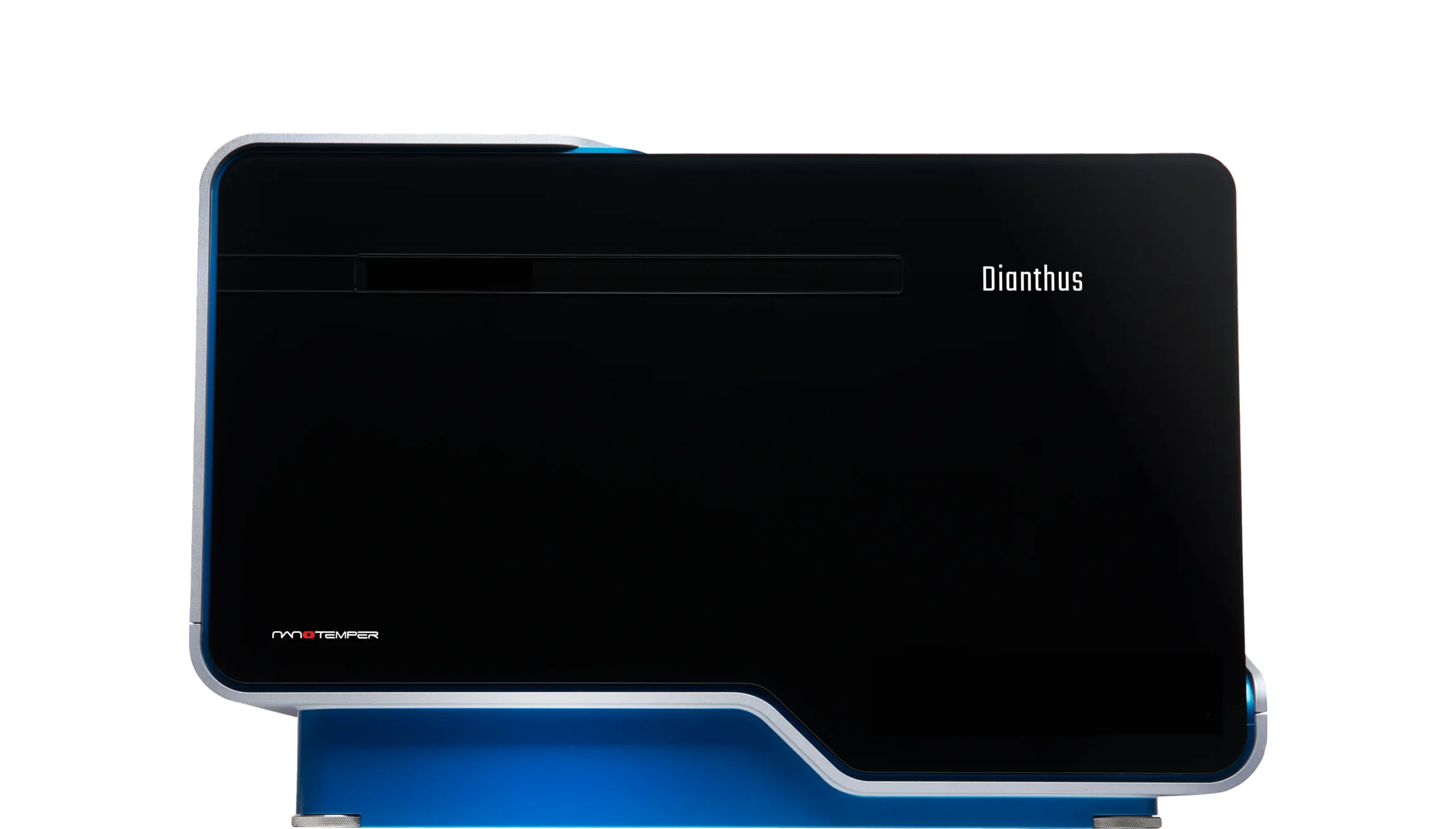
NanoTemper6288 dianthus

Fluorescence is temperature-sensitive

Most fluorophores exhibit temperature-dependent fluorescence. As temperature increases, fluorescence intensity typically decreases. This happens because higher temperatures increase the rate of non-radiative decay—energy dissipates as heat rather than light.

The magnitude of this temperature effect depends on the fluorophore’s chemical environment. A fluorophore buried in a hydrophobic protein pocket responds differently to temperature than one exposed to aqueous solution.

The chemical environment around the fluorophore changes upon binding

This can happen in several ways:
• Shielding from solvent: If binding buries the fluorophore in a more hydrophobic environment, it becomes less exposed to water.
• Conformational changes: Binding may cause the protein to fold or unfold, moving the fluorophore to a different location.
• Proximity to the ligand: The ligand itself may interact with or quench the fluorophore.

An infrared laser creates a rapid temperature jump

In a TRIC experiment, an infrared laser creates a localized temperature increase in the sample—typically a few degrees Celsius. This happens rapidly, within milliseconds.

The fluorescence intensity is measured before and after the temperature jump. The change in fluorescence is quantified as Fnorm (normalized fluorescence), calculated as the ratio of fluorescence after heating to fluorescence before heating.

Environmental changes alter how the fluorophore responds to the temperature increase. The Fnorm value shifts when the target is bound compared to when it’s unbound.

How it works.

<p>TRIC reveals ligand-induced aggregation</p>

How it works.

<p>TRIC reveals ligand-induced aggregation</p>

TRIC reveals ligand-induced aggregation

Like MST, TRIC can detect ligand-induced aggregation. Aggregation produces characteristic changes in the TRIC signal—often a sharp, non-sigmoidal change at higher ligand concentrations.
This aggregation detection is particularly valuable in fragment screening and small molecule discovery, where hydrophobic compounds frequently cause non-specific aggregation. TRIC identifies these problematic compounds, preventing false positives from advancing.
When TRIC is used as an orthogonal method to confirm hits from other assays, its aggregation detection capability often explains why some compounds showed activity in biochemical assays but aren't true binders—they're aggregators.
Better show than tell. See how DLS generates information about your sample.

Measuring binding affinity with TRIC.

In a TRIC experiment, you prepare samples containing:

  • A constant concentration of fluorescently labeled target
  • A dilution series of ligand

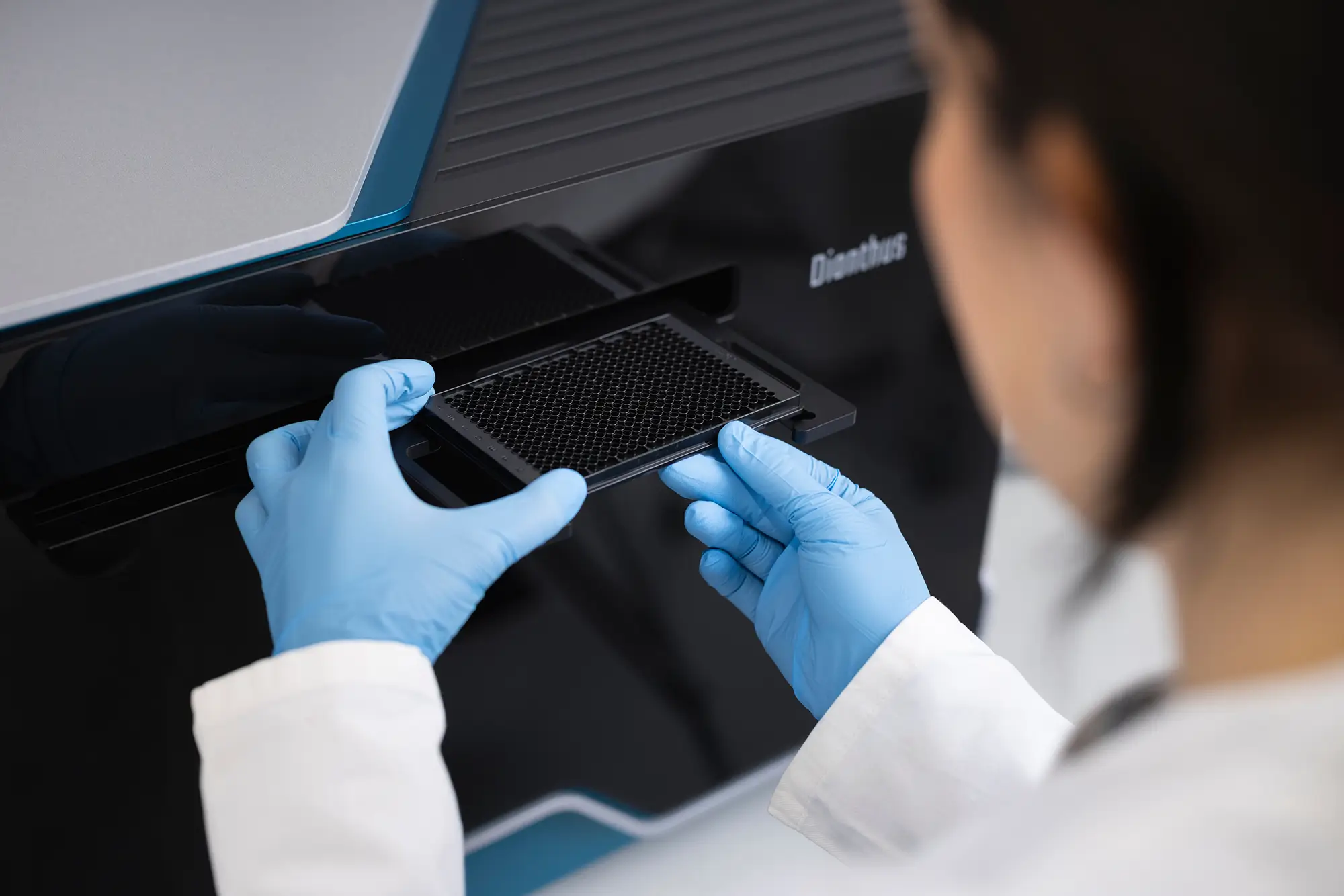
Each sample is loaded into a microwell plate. The IR laser heats each well briefly, and the fluorescence change is recorded.

Plotting Fnorm against ligand concentration produces a dose-response curve. The Kd is determined by fitting this curve to a binding model.

TRIC measurements are performed in standard microwell plates (96-, 384-, or 1536-well formats), making the technique compatible with high-throughput screening workflows.

graph
graph
graph
Thomas Schubert CEO at 2bind, Germany

“NanoTemper helps us turn challenging biophysical tasks into routine workflows. Their intuitive solutions give us reliable data faster, so our teams can focus on advancing drug candidates.”

Join the Newsletter

Get email updates. Your edge in biophysics. Subscribe today.

Privacy Policy(Required)

Frequently Asked Questions

What is Prometheus Panta by NanoTemper?

Lorem ipsum dolor sit amet, consectetur adipiscing elit. Integer tellus tellus, ornare a felis quis, semper tempus elit. Donec in facilisis magna.

Who benefits from using Prometheus Panta?

Lorem ipsum dolor sit amet, consectetur adipiscing elit. Integer tellus tellus, ornare a felis quis, semper tempus elit. Donec in facilisis magna.

What key features does Prometheus Panta offer?

Lorem ipsum dolor sit amet, consectetur adipiscing elit. Integer tellus tellus, ornare a felis quis, semper tempus elit. Donec in facilisis magna.

Is it possible to customize the interface of Prometheus Panta?

Lorem ipsum dolor sit amet, consectetur adipiscing elit. Integer tellus tellus, ornare a felis quis, semper tempus elit. Donec in facilisis magna.

Can Prometheus Panta connect with other NanoTemper tools?

Lorem ipsum dolor sit amet, consectetur adipiscing elit. Integer tellus tellus, ornare a felis quis, semper tempus elit. Donec in facilisis magna.