DLS - Dynamic Light Scattering.
DLS measures the diffusion of particles in solution to determine their size and size distribution.
When to use DLS.
The technique analyzes how quickly particles move due to Brownian motion. Smaller particles diffuse faster than larger ones, and this difference in motion creates measurable fluctuations in scattered light intensity.
DLS requires sufficient sample concentration and scattering intensity. Very dilute samples or very small particles may not scatter enough light for reliable measurements.
DLS is ideal when you need to:
When to use DLS.
The technique analyzes how quickly particles move due to Brownian motion. Smaller particles diffuse faster than larger ones, and this difference in motion creates measurable fluctuations in scattered light intensity.
DLS is ideal when you need to:
- Assess sample quality before other experiments (e.g., crystallography, cryo-EM, binding assays)
- Detect aggregation in protein preps or formulations
- Monitor oligomerization or complex formation
- Screen buffer conditions to minimize aggregation
- Track stability over time (e.g., during storage or freeze-thaw cycles)
DLS requires sufficient sample concentration and scattering intensity. Very dilute samples or very small particles may not scatter enough light for reliable measurements.
- Candidate library development
- Expression & Purification
- Developability Screening
- Formulation optimization
- Pre-clinical characterization
The science behind DLS.
Brownian motion drives particle diffusion
Particles in solution are constantly bombarded by solvent molecules, causing them to move randomly—a phenomenon called Brownian motion. The speed of this motion depends on particle size. Small particles are jostled more easily and move faster. Large particles are harder to move and diffuse more slowly.
When you shine a laser through a sample, particles scatter light. As particles move, the pattern of scattered light changes. DLS detects these changes by measuring the intensity of scattered light over time.
The autocorrelation function quantifies motion
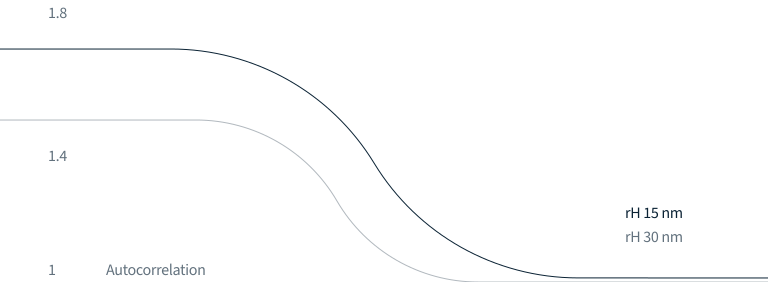
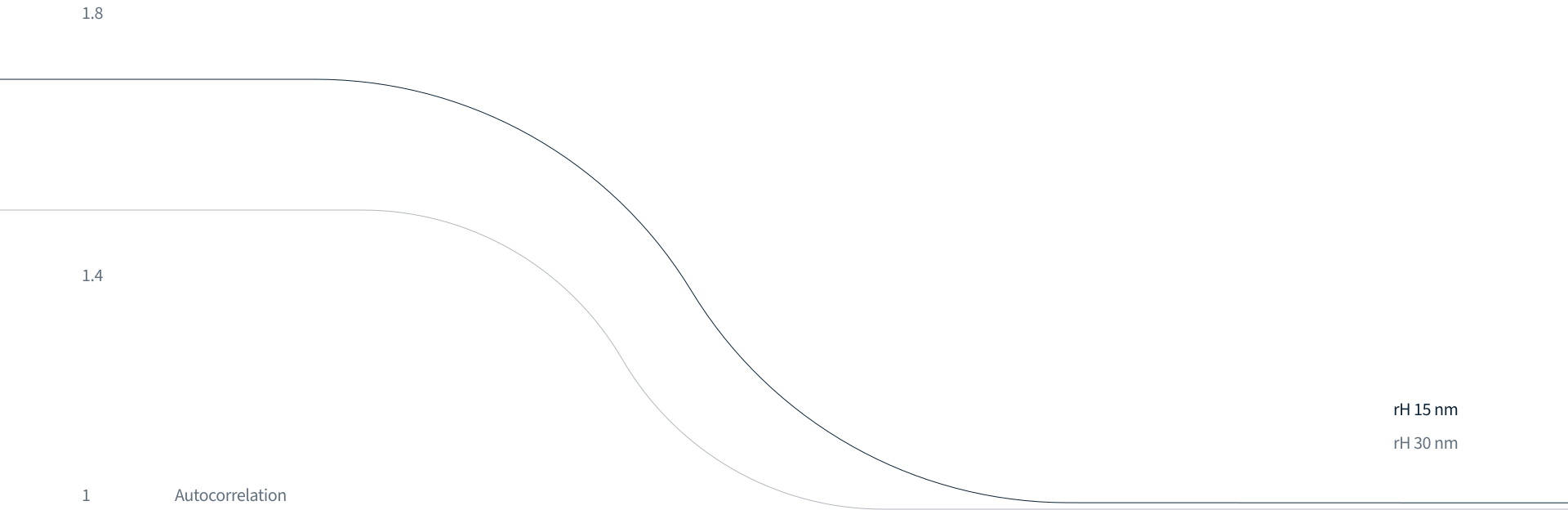
DLS instruments calculate the autocorrelation function (ACF) from the scattered light intensity data. The ACF describes how quickly the scattering pattern decorrelates—how fast the scattered light intensity fluctuates.
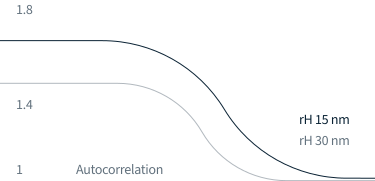
For small, fast-moving particles, the ACF decays rapidly because the scattering pattern changes quickly. For large, slow-moving particles, the ACF decays slowly. The decay rate is directly related to the diffusion coefficient of the particles.
From diffusion to size: the Stokes-Einstein equation
The diffusion coefficient is converted to hydrodynamic radius (rH) using the Stokes-Einstein equation:
Where:
- KB is Boltzmann’s constant
- T is temperature
- η is solvent viscosity
- D is the diffusion coefficient
The hydrodynamic radius includes the particle itself plus any associated solvent or hydration layer.
Fitting models extract particle size distributions
The ACF data is fit using mathematical models to extract size information. Two common approaches:
Cumulant analysis assumes a single population and calculates the average size (Z-average or cumulant radius) and polydispersity index (PDI). This is the most robust method for monodisperse samples.
Size distribution analysis resolves multiple populations and provides a distribution of particle sizes. This is useful for heterogeneous samples but requires higher quality data.
Parameters you measure with DLS.
Hydrodynamic radius (rH)
The effective radius of the particle as it diffuses through solution, including the hydration shell. Changes in rH can indicate conformational changes, oligomerization, aggregation, or binding events.
Polydispersity Index (PDI)
A measure of size distribution width. PDI ranges from 0 (perfectly monodisperse) to 1 (highly polydisperse). Low PDI (<0.1) indicates a uniform, well-folded protein. Higher PDI suggests heterogeneity—aggregates, misfolded species, or contaminants.
Size distribution
A plot showing the relative abundance of different particle sizes in the sample. Multiple peaks indicate distinct populations (e.g., monomer, dimer, aggregates).
Better show than tell. See how DLS generates information about your sample.
How DLS complements other techniques.
DLS measures colloidal stability — whether proteins stay uniformly dispersed in solution or form aggregates. This is distinct from conformational stability (measured by nanoDSF), which describes how well proteins maintain their folded structure.
A protein can be conformationally stable but colloidally unstable (aggregates even when folded). Combining DLS with nanoDSF gives you a complete picture of both conformational and colloidal stability.
In this graph, the protein has a high Tm, indicating that its formulation is optimal. However, based on the DLS data, we see that the protein is very prone to aggregation under these conditions. Relying on conformational stability alone could lead to development of the wrong candidate.
“NanoTemper helps us turn challenging biophysical tasks into routine workflows. Their intuitive solutions give us reliable data faster, so our teams can focus on advancing drug candidates.”
Our biophysical tools
that use DLS.
Join the Newsletter
Get email updates. Your edge in biophysics. Subscribe today.
Our latest research in Dynamic Light Scattering.
Frequently Asked Questions
Lorem ipsum dolor sit amet, consectetur adipiscing elit. Integer tellus tellus, ornare a felis quis, semper tempus elit. Donec in facilisis magna.