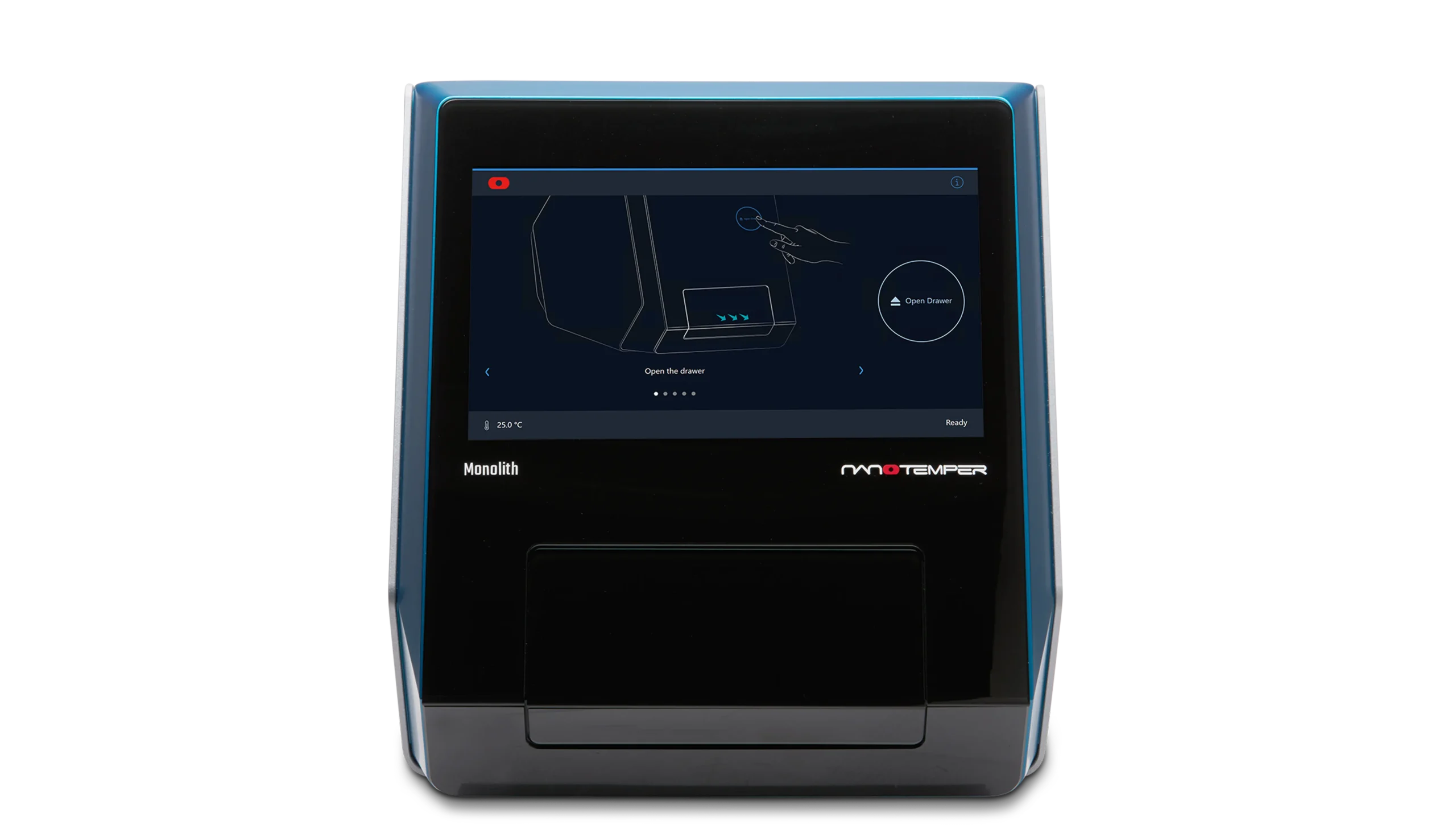
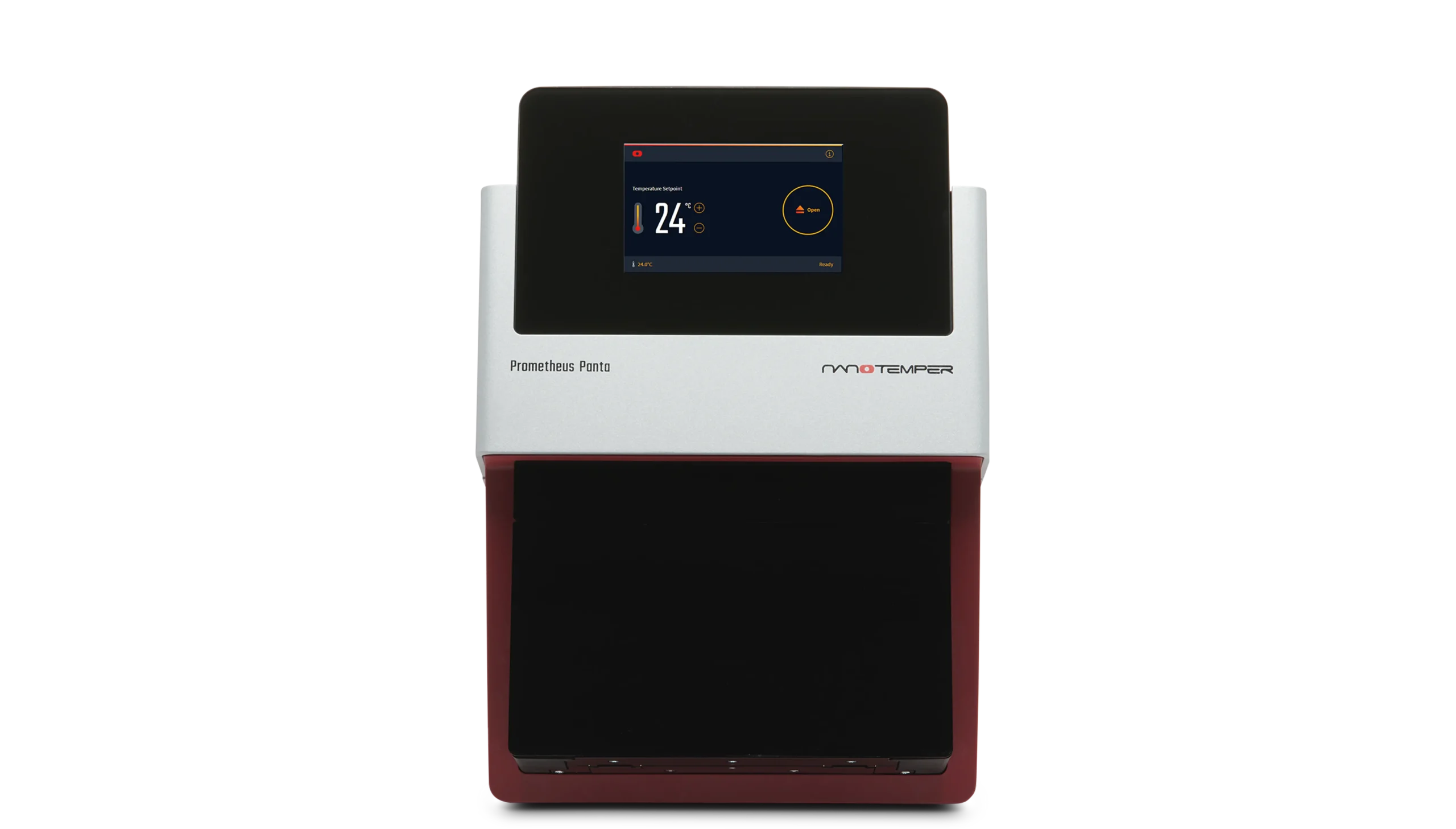
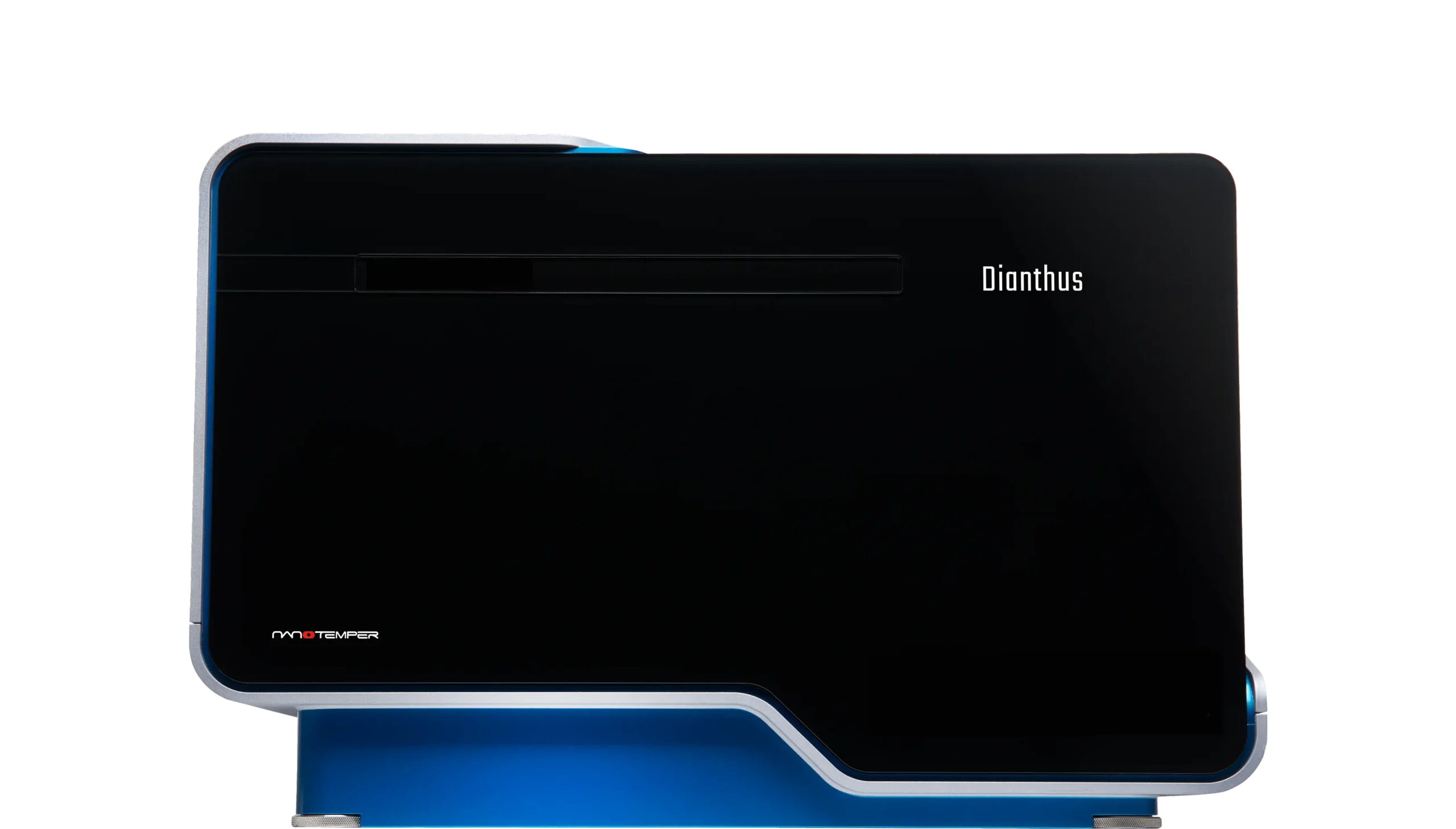
NEW: Kinetic profiling in solution starts with Monolith Omni

Find out more

AI-ready biophysical data

From experiment to model. And back again.

Generate structured, multi-parameter biophysical data for AI/ML workflows across drug discovery and biopharmaceutical development. Validate AI predictions, then use the results to guide the next round of experiments. Bring lab-in-the-loop to life.

Scientist reviewing structured biophysical screening data and analysis plots on a computer monitor for drug discovery research.

Quality in, quality out.

AI models are only as useful as the data behind them. NanoTemper instruments help teams generate structured biophysical data for model development, then bring predictions back to the lab for experimental validation.

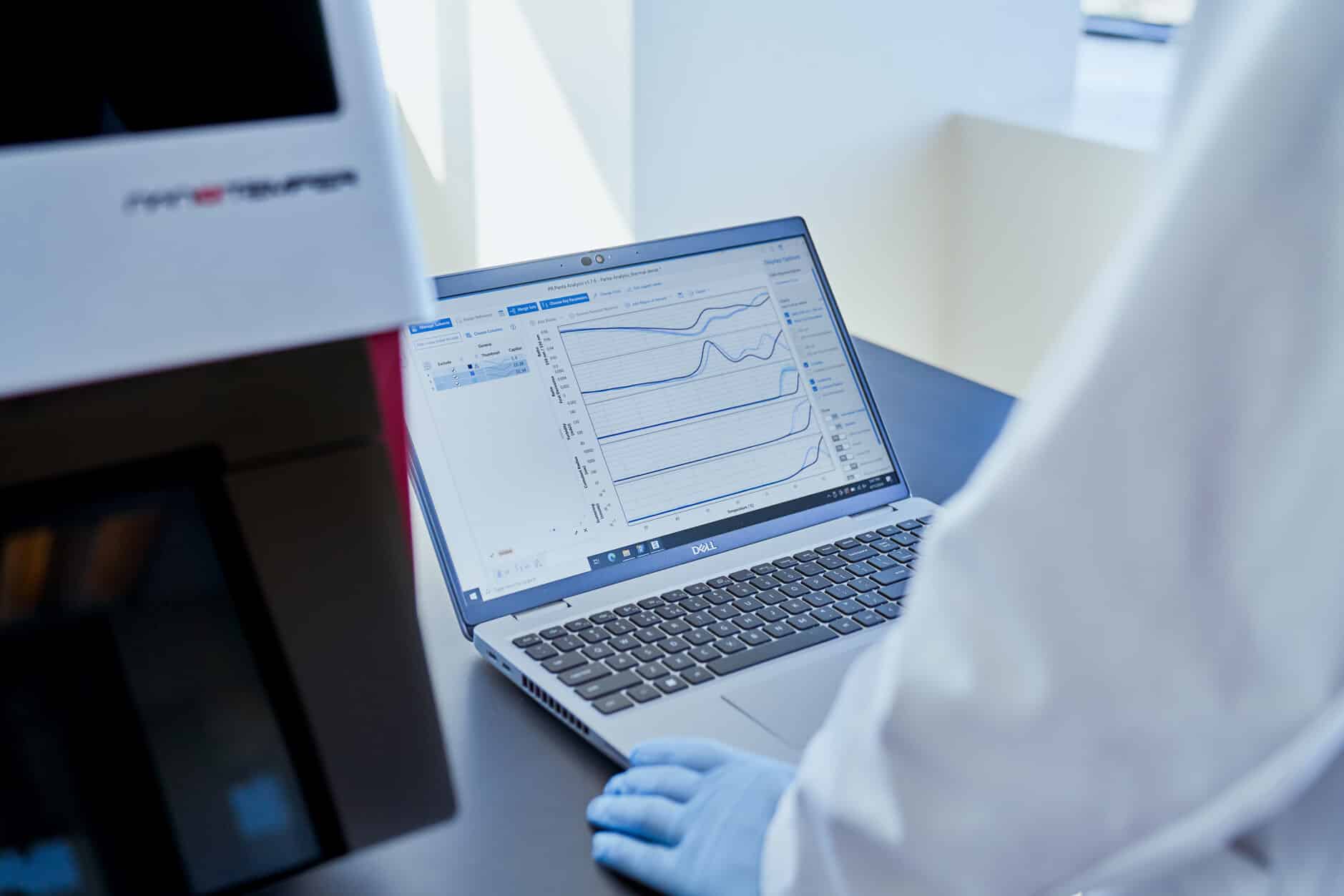
Scientist analyzing protein stability curves in Prometheus Panta Analysis software on a laptop

Build your models with precise data

Generate consistent, high-quality, high-throughput, multi-parameter biophysical data supporting AI and machine learning workflows, from model training to analysis and validation.

Validate in the lab

Use experimental measurements to evaluate AI predictions, confirm promising results, and to continuously improve your models.

Get data that integrates with your workflow

AI/ML workflows need data that can be accessed, structured, and reused without unnecessary manual steps. NanoTemper instruments provide machine-readable output, programmatic batch export, and options for automated data generation.
Solutions that address your AI needs.
Machine-readable data, out of the box

Solutions that address your AI needs.

Machine-readable data, out of the box

Machine-readable data, out of the box

The Prometheus Panta, Dianthus, and Monolith Omni instruments export raw data in JSON format. The data is structured and requires no conversion before it can be ingested into ML pipelines or analytical workflows.

Scriptable export for automated workflows

Scriptable export for automated workflows

Prometheus Panta and Dianthus support batch raw data export through a command line tool. Teams can retrieve data programmatically, without manual steps, and integrate it directly into scripted workflows.

Data generated at scale

Data generated at scale

Both Dianthus and Prometheus Panta systems support custom automation workflows through an open gRPC API, making it easier to connect them with existing laboratory infrastructure and scale biophysical characterization as needs grow.

Dianthus enables fast, plate-based affinity screening in 384-well format. For applications requiring even greater throughput, Dianthus uHTS scales biophysical screening with Spectral Shift to 1536-well plates. It measures 1,536 data points in a fully automated workflow in less than 6 minutes, delivering direct target engagement data for primary screening and hit validation. With seamless integration into automated laboratory workflows through gRPC, Dianthus uHTS can measure more than 1,000 Kd values per hour, or nearly 100,000 data points in a single working day.

Prometheus Panta Auto is a system for automated, label-free biophysical stability characterization of proteins. It enables rapid and easy screening of protein's stability profiles from samples prepared in 384-well plates. The Panta Auto instrument is a powerful tool for scientists working in AI-driven drug discovery, biologics developability, formulation development, and academic research, enabling them to screen at scale while maintaining data precision for confident decision-making.
Precision that powers your AI-assisted breakthroughs

Precision that powers your AI-assisted breakthroughs

Our technologies provide high reproducibility and sensitivity to train your models with data you can trust. 

Spectral Shift sensitivity: shifts can be detected as small as 50 picometer.
Spectral Shift limit of detection: 250 pM target concentration on the Dianthus platform.
Z prime: routinely above 0.5 in Dianthus and Dianthus uHTS screens.

Find more details about Spectral Shift precision in the respective product data files:
Download Dianthus data file.
Download Dianthus uHTS data file.

nanoDSF limit of detection: 5 µg/mL.
Precision of Tm: ±0.1 °C.

Find more details about nanoDSF precision in the Prometheus Panta data file. 

Open and FAIR integration

Open and FAIR integration

Open, structured data help teams integrate, find, access, reuse, and analyze results across tools, projects, and time when connected to customers' data-management systems (supporting FAIR-aligned workflows). Learn more about open and FAIR integration.
One experiment.
Rich, multiparametric data to power better models.

Prometheus Panta combines nanoDSF, backreflection, DLS, and SLS measurements to determine multiple critical protein profile parameters such as, Tonset, Tagg, Sizing, PDI and more for up to 48 samples at a time, in a single experiment. Monolith Omni measures affinity, kinetics, and stability in one run, using the sample, in under 30 minutes. This multi-parameter approach creates more context for each sample, enhances assay efficiency and can help reduce variability between separate assays. Consistent development of high-fidelity data can propel AI model development and validation.
Solution

Structured data for model development

The consistency and structure of NanoTemper data makes it easy to integrate datasets as training input for machine learning or deep learning models. Multiple large AI enabled drug discovery organizations utilize the Dianthus and Prometheus Panta for their training dataset generation and validation of model predicted outputs

NTT AI Icon Three Dots 03 full

Predictions to bring back to the lab

Biophysical measurements from NanoTemper instruments can serve as experimental ground truth to confirm or challenge predictions made by AI and in silico tools.

Users globally are already using NanoTemper solutions to validate results within their AI-driven drug discovery workflows.

How high quality data from NanoTemper instruments support AI-ready workflows in practice.

Isabel Waibel PhD Student
ETH Zürich
Watch the webinar

“The most critical thing in the whole process is to make sure that the measurement data we generate is of high quality, with measurement noise much smaller than the effects of the excipients. Only with this low measurement noise can we train our models accurately and identify optimized formulations. Using Prometheus™ Panta to measure thermal and colloidal stability, we applied Bayesian optimization and identified near Pareto-optimal formulations in just 33 experiments.”

Frequently asked questions about AI-ready biophysical data.

How do NanoTemper instruments support AI and machine learning workflows?

NanoTemper instruments help scientists generate structured, high-quality biophysical data for AI and machine learning workflows. The data can be used as model-training input, incorporated into analytical pipelines, and brought back to the laboratory to experimentally validate AI predictions.

What makes NanoTemper data AI-ready?

NanoTemper data is AI-ready because it is high-quality, structured, machine-readable, and available for automated export. Instruments can provide raw data in JSON format, reducing the need for manual data conversion before results are used in machine learning pipelines or other analytical workflows.

Which NanoTemper instruments support machine-readable data workflows?

The Prometheus Panta, Dianthus, and Monolith Omni support raw data export in JSON format. This enables teams to access structured results for analysis, data integration, model development, and experimental validation.

Can NanoTemper data be exported automatically?

Yes. Prometheus Panta and Dianthus support batch raw data export through a command-line tool. This allows teams to retrieve data programmatically and integrate it into scripted or automated workflows without relying on manual export steps.

How can NanoTemper instruments be integrated into automated laboratory workflows?

NanoTemper instruments provide options for automated data generation and workflow integration. Dianthus uHTS can be operated through gRPC for automated screening workflows, while Prometheus Panta Auto can load up to 1,536 samples using 384-well plates or can also be integrated into an existing automation workflow through gRPC.

How much data can Dianthus uHTS generate for AI model development?

Dianthus uHTS can measure 1,536 data points in less than 6 minutes, or more than 1,000 Kd values per hour, reaching nearly 100,000 data points in a single working day, through automated laboratory workflows via gRPC. This throughput can help teams build larger structured biophysical datasets for AI-supported drug discovery and validate model predictions at scale.

What type of data does Prometheus Panta generate for AI and machine learning models?

Prometheus Panta generates multi-parameter protein stability and colloidal stability data. In a single experiment, it can combine nanoDSF, Backreflection, dynamic light scattering, and static light scattering measurements for up to 48 samples. Results can include parameters such as melting temperature, onset temperature, aggregation temperature, particle sizing, and polydispersity index.

Why are multi-parameter measurements useful for AI workflows?

Multi-parameter measurements provide more context for each sample in a single experiment. Combining several measurements provides richer training or validation data for AI and machine learning models.

What type of biophysical data can be used to support AI-driven formulation development?

Protein thermal and colloidal stability data can support AI-driven formulation development. For example, Prometheus Panta can measure stability-related parameters that help researchers compare formulations, identify promising conditions, and provide experimental data for model- based formulation optimization.

How does Monolith Omni support AI-driven drug discovery?

Monolith Omni provides solution-based binding affinity measurements with minimal sample consumption. Its affinity data can be used to support binding-model development, compare compounds or candidates, and experimentally evaluate predictions generated by AI or other in silico tools.

Can NanoTemper measurements validate AI predictions?

Yes. NanoTemper measurements can serve as experimental ground truth for confirming, challenging, and refining predictions made by AI and other computational tools. This creates an iterative workflow in which models generate predictions, laboratory measurements test those predictions, and the resulting data can be used to improve future model development.

How does the “quality in, quality out” principle apply to AI-driven biophysical workflows?

AI models are only as reliable as the data used to develop and evaluate them. Consistent, precise, reproducible, and sensitive biophysical measurements provide a stronger foundation for model training, analysis, and experimental validation.

What does open and FAIR mean for AI-ready biophysical data?

Open and FAIR means designing data so results can be found, accessed, reused, and analyzed across tools, projects, and time. Structured data formats help teams connect biophysical results with analytical workflows, data platforms, and AI or machine learning pipelines.

Can NanoTemper data be reused across projects and analytical workflows?

Yes. Machine-readable JSON output, programmatic batch export, and structured data workflows make it easier for teams to access and reuse results across projects and analytical tools. This supports applications ranging from model training and analysis to experimental validation and workflow automation.

Which NanoTemper solution should scientists use for AI-ready data generation?

The appropriate solution depends on the scientific question:

  • Prometheus Panta: Protein thermal and colloidal stability characterization, including multi-parameter stability data.
  • Dianthus: Solution-based binding affinity measurements and screening workflows.
  • Dianthus uHTS: Ultra-high-throughput binding screening for large-scale screening campaigns.
  • Monolith Omni: Solution-based binding affinity measurements.

Each platform generates data suited to different stages of drug discovery, biopharmaceutical development, model development, and experimental validation.

How do NanoTemper instruments fit into a lab-in-the-loop workflow?

NanoTemper instruments can support a lab-in-the-loop workflow:

  1. Generate structured data from biophysical measurements.
  2. Export the data for analysis or model development.
  3. Use AI or machine learning models to generate predictions.
  4. Test those predictions experimentally with biophysical measurements.
  5. Feed the new results back into the workflow to guide the next round of experiments.

This approach connects computational predictions with laboratory evidence and helps scientists make faster, more confident decisions.

Join the Newsletter

Get email updates. Your edge in biophysics. Subscribe today.

Privacy Policy(Required)